Before changing a provider or adding customer-visible fees, U.S. businesses should calculate their effective processing rate.
To reduce credit card processing fees, compare total monthly credit card processing costs with total card sales instead of relying on an advertised rate.
This shows what your business actually pays across credit card transactions.
Review the statement and provider agreement for interchange, network assessments, processor markup, fixed charges and other processing fees.
Legitimate credit card costs generally cannot all be removed, but a careful review can reveal unclear, unnecessary or potentially negotiable fees without creating friction for customers.
Want to understand what you are really paying?
Request a free, confidential Merchant Fee Audit.
There is no obligation, and no provider switch is required.
Before making changes, consider transaction volume, card types, payment methods, pricing and additional services.
The goal is to manage processing fees responsibly, preserve reliable payment options and protect sales.
Key Takeaways
- Calculate your effective credit card processing rate before changing providers or payment practices.
- Review statements for unclear, unnecessary or potentially negotiable processing fees.
- Compare total credit card processing costs, not only a quoted rate or single fee.
- Evaluate customer-visible options carefully so convenient payments and sales are not compromised.
- Use the Merchant Fee Audit to clarify payment costs and make an informed business decision.
The Hidden Cost of Credit Card Processing
Credit card processing fees include several components, and a business’s total cost can vary by card, transaction method, industry, risk profile, processing volume, pricing model and provider agreement.
The effective rate reflects actual processing costs after applicable fees rather than an advertised rate alone.
What Goes Into Your Processing Fees
There are three primary categories to understand:
- Interchange Fees: Interchange fees are set by card networks and paid to the cardholder’s bank. An interchange fee varies by card type, transaction method, industry and other conditions. Credit cards and debit cards may have different fee structures, so individual card transactions can have different costs.
- Assessment Fees: Card networks apply assessment fees to eligible transactions. These network charges vary by network, transaction type and applicable rules. Legitimate interchange and assessment costs generally remain part of accepting cards.
- Processor’s Markup: A processor’s markup is the amount charged by a payment processor or other payment processors for processing services. It may appear as a percentage, per-transaction charge, flat-rate arrangement or separate component under interchange-plus pricing. Interchange-plus can improve visibility but does not automatically lower total costs.

Other processing fees may include payment gateway charges, monthly minimums, account fees, batch or settlement fees, PCI-related fees, equipment or software charges, chargebacks and refunds.
Review unused services and compare statements with the agreement over a representative period.
Some processors combine costs into a flat rate, while others list them separately.
This review may help a merchant identify unclear, avoidable or potentially negotiable charges, but no particular fee should be assumed removable.
Why Small Businesses and Nonprofits Feel the Pinch
Processing costs affect small businesses and nonprofit organizations differently based on sales volume, average transaction amount, card mix and the provider agreement.
A smaller organization may have fewer transactions over which to spread fixed fees, while another business may already have competitive pricing.
Higher volume can sometimes support different rates, but it does not guarantee lower costs.
For a nonprofit, fees can reduce funds available for programs.
For a local business, they can affect margins and cash flow.
The practical first step is to understand which fees apply, how they are calculated and whether current pricing reflects actual payment activity.
Clear information helps businesses compare providers and seek ways to lower credit card processing fees without restricting useful payment options or creating unnecessary friction for customers.
How to Reduce Credit Card Processing Fees Without Hurting Sales
Businesses can review credit card processing costs without reducing payment options or creating unnecessary checkout friction.
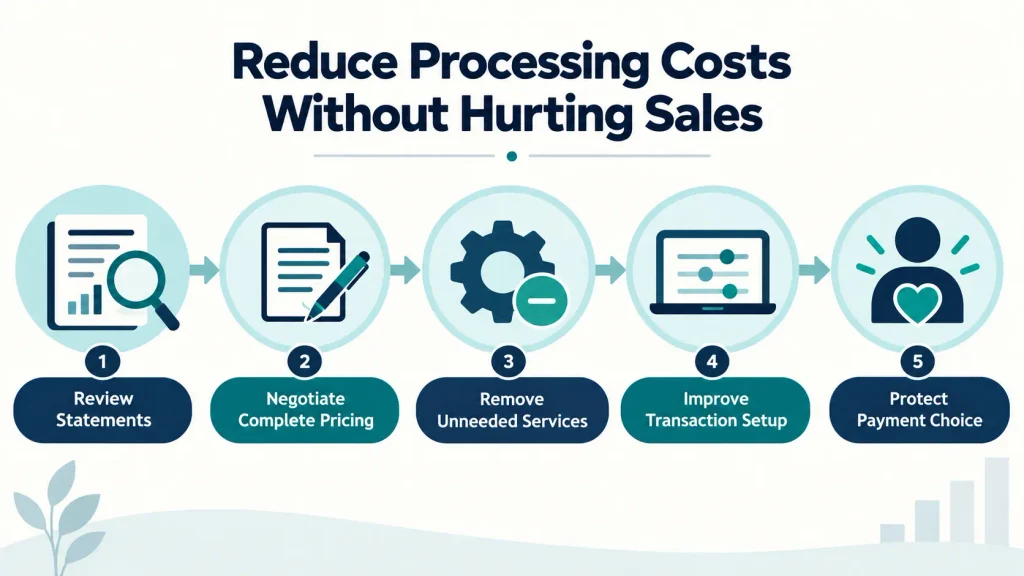
To reduce merchant processing fees, combine statement analysis, provider discussions and transaction practices that fit the business, customers and sales process.
Negotiating Better Rates With Your Provider
Ask your provider to explain the current pricing structure and total processing fees in writing.
Review the agreement before requesting changes, then compare the effective rate with complete offers from other payment processors.
A lower advertised rate may not reduce total costs if it includes higher fixed charges or additional fees.
- Request a regular review: Discuss transaction volume, average ticket, card mix and payment methods with your provider.
- Compare total pricing: Ask how percentage rates, per-transaction charges, monthly minimums, gateway fees and other costs affect the final amount.
- Evaluate alternatives carefully: Obtain written terms from competing providers and compare each complete agreement rather than one advertised rate.
Interchange-plus pricing can improve visibility into card processing charges and interchange fees, but it does not automatically lower processing fees for every business or merchant.
Reviewing Your Statement Line by Line
Review each statement against the contract. This can help you identify unclear or potentially avoidable charges and manage credit card processing costs. Look for:
- Effective rate and qualified or nonqualified transaction categories
- PCI-related fees and compliance requirements
- Monthly minimums, account fees and payment gateway charges
- Batch settlement fees and other per-transaction charges
- Equipment, software and unused service charges
- Chargeback costs, refunds and other nonprocessing add-ons
Ask the provider to explain the purpose and calculation of every unfamiliar fee.
Some charges may be negotiable or conditionally avoidable, while legitimate network or interchange costs may remain.
Compare total fees over a representative period instead of focusing only on the lowest rate.
Protecting the Customer Experience While You Cut Costs
The first four methods below generally happen behind the scenes.
Surcharges and cash discounts are visible to customers and may influence purchasing behavior, so consider customer expectations, competitors, applicable laws, card-network rules and disclosure requirements.
This is general information, not legal advice.
| Method | Visible to customers? | Possible sales impact | Important consideration |
|---|---|---|---|
| Statement audits | No | Usually limited | Identify unclear or potentially negotiable fees. |
| Provider negotiation | No | Usually limited | Compare complete pricing, not one quoted rate. |
| Removing unnecessary services | No | Usually limited | Cancel only services the business does not need. |
| Improving transaction setup | No | Usually limited | Use accurate data and suitable payment settings. |
| ACH for suitable invoices | Sometimes | Customer adoption may vary | Offer it when it fits the invoice and customer preference. |
| Credit card surcharges | Yes | Customers may change payment behavior | Review laws, network rules and disclosure requirements. |
| Cash discounts | Yes | Customers may respond differently | Present the pricing clearly and consistently. |
Address verification may support fraud screening but does not eliminate fraud or chargebacks.
Follow settlement requirements when batching transactions, offer debit cards without improperly restricting credit card access, and test any payment change against customer feedback, approval rates and reliability.
Calculate Your Effective Credit Card Processing Rate
Use the same month’s total card sales and processing fees to calculate the effective rate for your business.
This rate reflects the overall cost of credit card processing, not just one quoted fee or advertised rate:
Effective rate = Total monthly processing fees ÷ Total monthly card sales × 100
| Monthly card sales | Current fees | Current effective rate | Example revised fees | Illustrative annual difference |
|---|---|---|---|---|
| $100,000 | $3,200 | 3.20% | $2,700 | $6,000 |
In this illustrative example, $3,200 ÷ $100,000 × 100 = 3.20%. Reducing processing fees from $3,200 to $2,700 would equal $500 per month, or $6,000 per year.
This is an illustrative calculation, not a predicted audit result or guaranteed saving for any business.
Introducing the Merchant Fee Audit
A Merchant Fee Audit reviews your payment processing costs and current pricing structure.
The free, confidential, no-obligation review examines statements and identifies unclear, unnecessary or potentially negotiable costs.
Businesses do not have to switch providers, accept a proposal or change payment services to consider the findings.
The review may examine key components of credit card processing and card processing fees:
- Interchange fees: Network-set charges associated with a card transaction and the cardholder’s bank. Interchange fees may differ by card type, transaction method and other conditions.
- Assessment fees: Charges applied by the relevant card network to eligible transactions.
- Processor markup: The amount added by the processor under the applicable pricing arrangement.
- Other processing charges: These may include PCI-related fees, monthly fees, gateway fees, settlement charges and other account services.
The audit reviews available statements and may consider credit cards, debit cards, card transactions, transaction types, card mix, average ticket size, transaction volume and current pricing.
These factors affect the total cost of payment processing and help show whether the existing arrangement fits the business’s activity.
Its purpose is to support an informed decision by clarifying fees, costs and the effective rate.
Findings can help businesses evaluate their current processor, discuss options with providers or take no action.
Any estimated savings should be based on the business’s records, fees, pricing and payment activity rather than a fixed promise.
Through Reverse Fundraising, a participating business may voluntarily support a nonprofit if savings are identified.
Any contribution is optional and separate from receiving the free audit; a business does not need to support a nonprofit to receive or consider the review.
What to Expect From a Free Audit
A free Merchant Fee Audit follows five steps to review a business’s credit card processing costs, organize statements and clarify processing fees before the business decides whether to act.
The Process Step by Step
The process includes the following:
- Reach Out: Contact the audit provider and provide basic information about the business, payment services and review request.
- Provide Statements: Submit the requested processing statements or other documents for the relevant statement period.
- Review Process: The provider reviews available pricing, transaction volume, card mix, payment methods, credit card processing fees and the effective rate. The review may also consider transaction amounts, cards, chargebacks and other account activity.
- Receive Findings: Review a summary of current fees, potential cost differences and the basis for any estimated savings or recommendations.
- Decide Next Steps: Ask questions, discuss options with the current processor or take no action. The business decides whether to change services, contact providers or keep its current arrangement.
| Step | What happens | What the business receives or decides |
|---|---|---|
| 1. Reach Out | The business submits an audit request and basic account information. | It decides whether to provide statements for review. |
| 2. Provide Statements | Relevant processing statements and supporting documents are submitted securely. | The audit has the information needed to examine pricing and fees. |
| 3. Review Process | Available transactions, processing costs, card mix, pricing and the effective rate are analyzed. | The business receives a clearer view of its credit card processing arrangement. |
| 4. Receive Findings | The audit results explain current charges and any identified opportunities for review. | The business considers the findings and asks questions about the costs or estimates. |
| 5. Decide Next Steps | The business evaluates its options with no required provider change. | It may negotiate, compare services, change nothing or pursue another decision. |

Timing and Confidentiality
The review is free, confidential and no-obligation.
Businesses should provide only the documents needed for the audit and review how submitted financial information will be handled.
Findings are based on the business’s statements, transactions, processing fees, pricing and provider agreement.
Setting Realistic Expectations
Credit card processing fees and card processing costs depend on each business, so an audit identifies current expenses and possible options rather than predicting a specific result.
Businesses generally cannot eliminate credit card processing fees completely because legitimate interchange, network, bank and processor costs remain part of accepting cards.
Why Results Vary
Several factors can affect rates and total costs:
- Transaction Volume: The number and amount of transactions may influence available pricing, but higher volume does not guarantee better rates.
- Average Ticket Size: The cost of each transaction can affect the effective rate and total processing fees.
- Card Mix: Credit cards and debit cards may carry different interchange fees and processing costs.
- Industry and Risk: Industry characteristics, transaction methods, cash flow and risk considerations can influence pricing.
- Current Pricing Model: Interchange-plus may provide greater visibility into interchange and processor markup, but it does not automatically lower total costs for every business.
- Processing History: Payment history, chargebacks, a chargeback rate and account activity may affect how a processor evaluates an account.
Some businesses may identify savings, while others may already have competitive pricing.
A useful comparison considers all fees, the customer payment experience and the complete agreement, not only one advertised rate.
No Pressure
An audit is an information-gathering tool.
It can show current credit card processing expenses and possible alternatives, while the business decides whether to contact providers, change its pricing model or take no action.
Any dollar calculation presented elsewhere is illustrative, not a prediction of savings or revenue.
The objective is to manage fees responsibly, preserve convenient payments and identify unnecessary or unclear costs without assuming that every fee can be removed.
Conclusion
Reviewing credit card processing fees, statements and total pricing helps businesses make informed payment decisions.
Compare the effective rate, ask the processor to explain unfamiliar charges and consider the customer experience before changing providers, payment methods or checkout practices.
This approach can help you reduce credit card processing fees without undermining sales or reliable service.
A Merchant Fee Audit provides a free, confidential and no-obligation review of payment processing costs.
It can clarify how interchange, processor charges, card transactions and other fees affect a business, helping merchants evaluate options based on their records and payment needs.
Through Reverse Fundraising, a participating business may voluntarily support a nonprofit if savings are identified.
Any contribution is optional and separate from receiving the free audit, and the amount is determined independently by the business.
Legitimate credit card processing fees generally cannot be eliminated entirely because network, bank and other payment costs remain.
Careful review can help businesses manage card processing costs and protect the customer experience.
See whether your current processing costs can be improved.
Start your free, confidential Merchant Fee Audit today—without changing providers or committing to any recommendation.
FAQ
What is a good effective credit card processing rate?
A good rate depends on the business’s card mix, transaction methods, pricing model, industry and sales volume. Compare the effective rate and total costs with similar providers rather than relying on one advertised rate.
How do I calculate my effective processing rate?
Use this formula: Effective rate = Total monthly processing fees ÷ Total monthly card sales × 100. Include applicable processing fees and card transactions for the same month.
How can a business reduce credit card processing fees?
To reduce credit card processing fees, review statements, compare the effective rate, identify unnecessary services, improve transaction setup and negotiate complete pricing with providers. Preserve convenient payment options for customers.
Can processing fees be eliminated completely?
No. Legitimate processing fees generally cannot be eliminated completely. Interchange fees, network assessments, processor costs and other payment expenses may remain when a business accepts credit cards and debit cards.
Does a Merchant Fee Audit require switching processors?
No. A Merchant Fee Audit reviews available statements, pricing, transactions and applicable fees, but the business can keep its current processor, accept or reject recommendations, and decide whether to take action.